
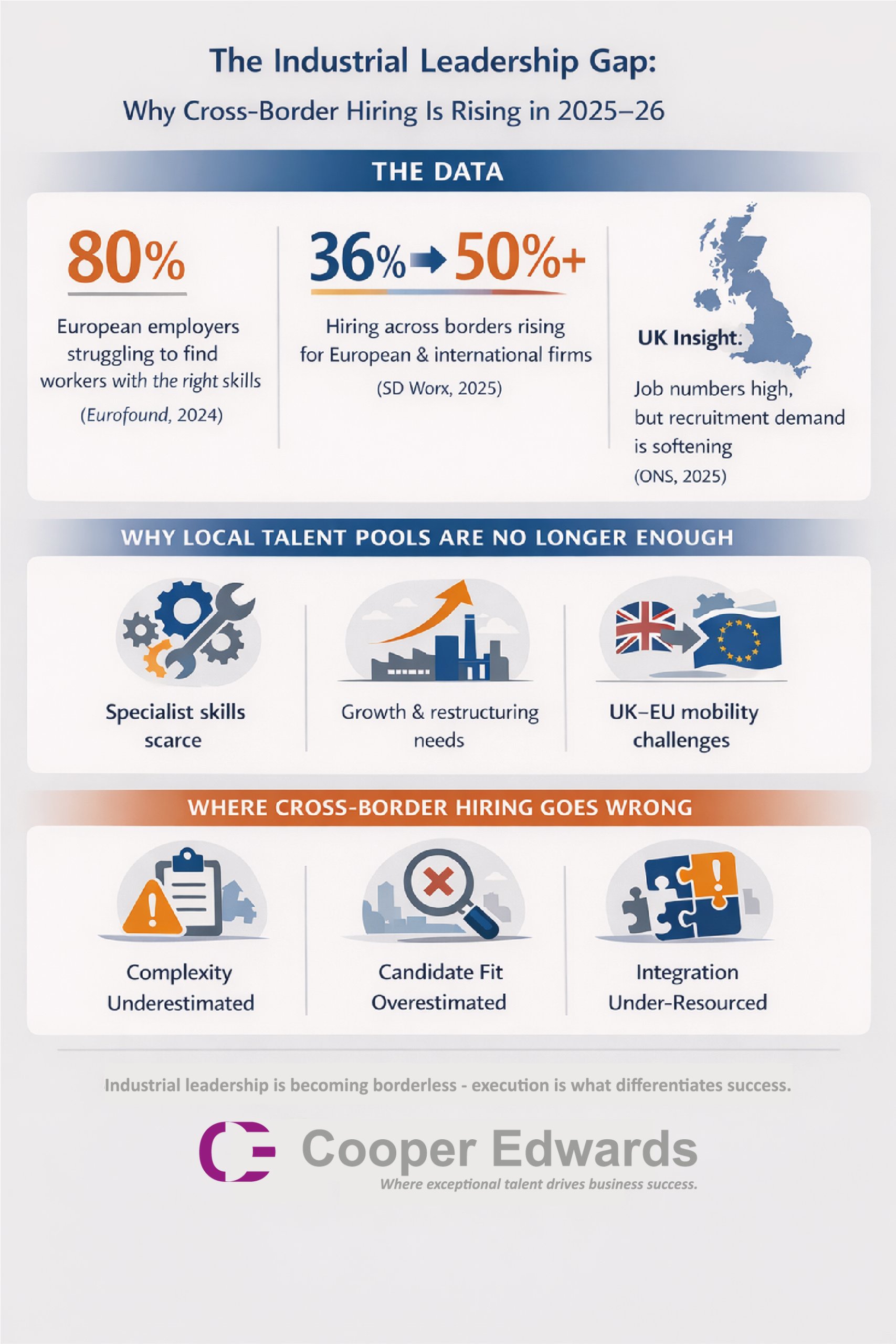
The Industrial Leadership Gap: Demand for Cross-Border Talent Rising in 2025–26
In 2025, industrial SMEs in both the UK and Europe are showing a clear pattern: traditional local talent pipelines are no longer sufficient, and demand for cross-border leadership and niche skills is rising. Yet firms face structural challenges when bridging borders to secure the right executives.
Data Signals: Labour Markets Tight but Skills Scarce
• Eurofound reports that 80% of European employers struggle to recruit workers with the right skills, with many firms resorting to hiring without required competencies just to fill roles. Administrative and qualification recognition barriers persist for cross-border candidates. Eurofound
• A pan-European survey (SD Worx HR & Payroll Pulse 2025) finds that ~36% of employers in Europe are hiring across borders to broaden their talent pools. This rises above 50% for international firms, with the UK significantly above the European average. TechTalents Insights
• Meanwhile, UK labour market data shows the number of workforce jobs rising modestly through 2025, but broader economic momentum is slowing and recruitment demand softening, suggesting that businesses must compete harder for the right skills. Office for National Statistics
These figures underline a paradox in 2025: labour markets are not overflowing with available talent, but the right talent for industrial leadership and growth roles remains scarce. For industrial SMEs, especially those scaling internationally or operating across UK–EU borders, this creates distinct pressures on hiring strategies.
Why Cross-Border Hiring Is Increasing for Industrial SMEs
- Specialised Skill Shortages at Senior Levels:
Industrial SMEs (manufacturing, engineering, supply chain operations) increasingly report lack of experienced leaders with cross-market operational expertise. Traditional domestic executive pools often lack the specific combination of sector, regulatory, and cross-border experience that European-owned subsidiaries or export-oriented UK SMEs need. - Mobility Rules and Recognition Barriers:
Unlike the pre-Brexit single market framework that eased mobility and qualifications recognition, post-2020 labour mobility is fragmented. UK SMEs recruiting from EU markets must navigate visas and work-permit regimes; EU firms recruiting in the UK face similar complexities, especially for senior hires. Administrative friction increases timelines and recruitment costs. - Skills Mismatch and Training Gaps:
Even where candidates are available, mismatches between advertised requirements and actual applicant skills are common. Employers report needing to invest in training, upskilling, and relocation support if cross-border hires are to succeed, often a cost and strategic commitment many SMEs underestimate.
Pitfalls in Cross-Border Leadership Hiring
Common Pitfalls Industrial SMEs Encounter:
- Underestimating complexity: visa processes, qualification recognition and relocation logistics often take longer and cost more than expected, delaying impact in critical leadership roles.
- Confusing reach with fit: expanding the talent pool does not guarantee the right sector, scale or regulatory experience, particularly at MD and GM level.
- Weak integration planning: without structured onboarding and cultural alignment, even strong cross-border hires can struggle to deliver quickly or stay long term.
Net result: increased risk, slower ROI, and leadership instability at precisely the moment businesses need continuity.
What Works in 2025–26
- Map the Market with Data, Not Assumptions:
Use labour mobility and vacancy data (e.g., EURES, Eurostat labour mobility trends) to identify where leadership talent clusters and where skills are most in demand. Mapping market imbalances helps target recruitment efforts more effectively. - Build Talent Pipelines Pre-Border:
Engage with talent communities, sector associations, and cross-border leadership networks before roles become urgent. This builds relational capital and shortens future search cycles. - Invest in Structured Cross-Border Onboarding:
Formalise relocation supports, regulatory training, and cultural onboarding. Leaders who feel supported tend to deliver strategic value more quickly and stay longer. - Treat Skills Mobility Strategically:
Rather than reactive hiring, SMEs should view cross-border leadership as part of long-term workforce strategy, thereby anticipating where skill shortages will most impact competitiveness and embedding mobility into workforce planning.
I’ve worked extensively in 2025 with European headquarters hiring Managing Directors and GMs for their UK operations. What stands out is beyond the simple need for cross-border talent: it’s how many organisations still treat such hires as transactional rather than strategic. Successful industrial SMEs in 2025 are those that build mobility into their talent architecture and recognise that hiring across borders is as much about integration and development as it is about search.
If 2026 is to be the year industrial leaders break through the “leadership gap,” data-driven talent sourcing and strategic mobility planning will be the differentiators.
#IndustrialLeadership #CrossBorderHiring #ExecutiveSearch #IndustrialSMEs #ManufacturingLeadership #EngineeringLeadership #TalentStrategy #FutureOfWork
#UKIndustry #EuropeanIndustry