
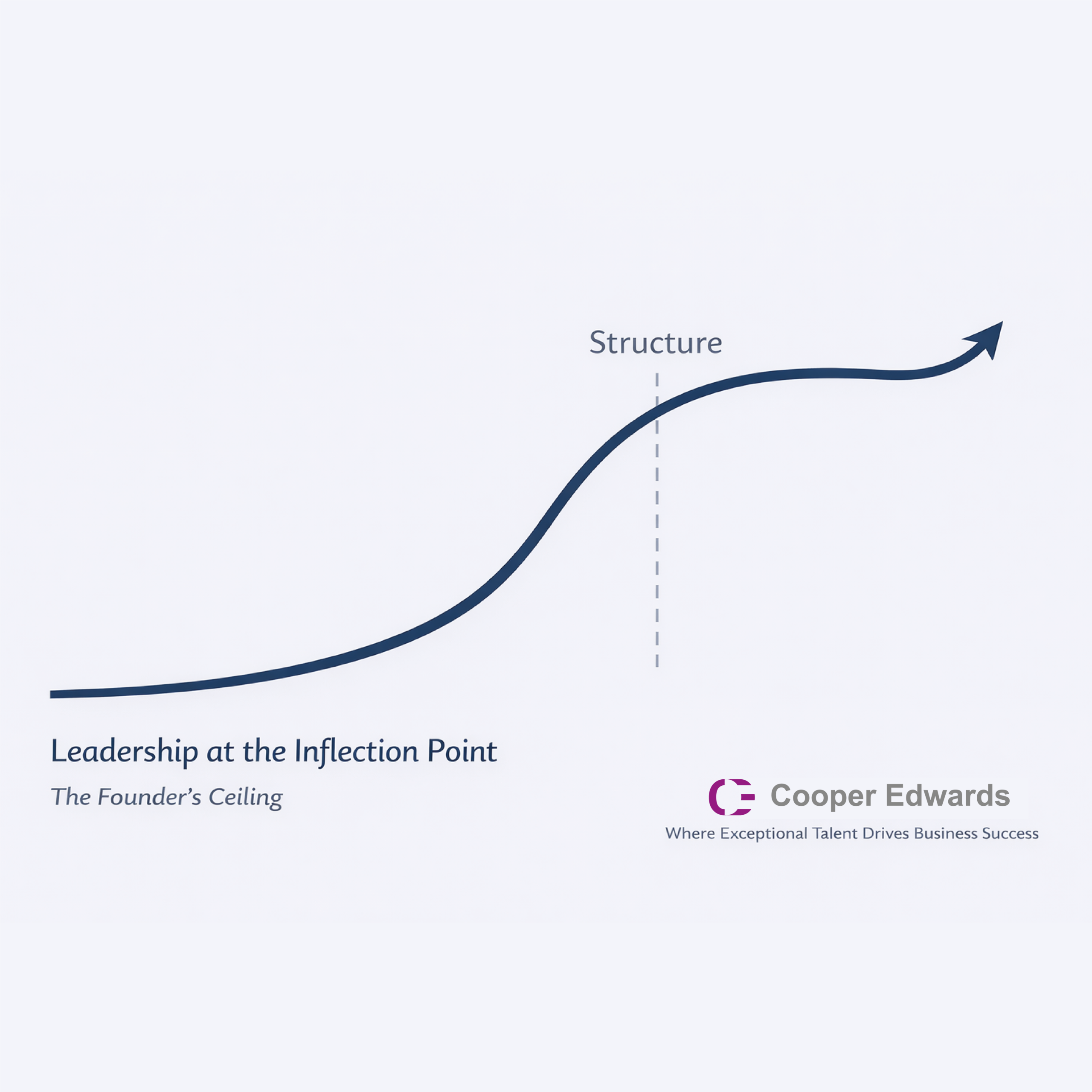
The Founder’s Ceiling: When Vision Outgrows Structure
In several of our recent conversations with founders and SME owners, be it in manufacturing or services, a familiar theme has surfaced: the business is growing, the order book looks strong, on paper everything appears positive. And yet something feels harder than it used to: the leadership team looks busy but not always aligned, good people seem stretched, and the founder is still involved in everything.
In a number of recent appointments throughout the UK and Europe alike, we were brought in at exactly this point: not during early success, and not during failure, but at the moment growth began to strain the operating model. This is what I often think of as the founder’s ceiling.
In the early years, founder-led intensity is a competitive advantage: speed beats structure, proximity to customers drives growth, instinct carries the business forward.
But as revenue moves towards £10m, £20m, £30m, £40m and beyond, complexity multiplies quietly as layers appear, communication becomes less direct and informal accountability starts to create friction. The leadership architecture has not expanded alongside the organisation.
In several recent searches, CEOs have described the same tension:
- “I’m still the escalation point for too many decisions.”
- “My team is capable, but I don’t always feel challenged.”
- “We’ve outgrown the way we used to run the business.”
Whilst many of these founders are exceptional operators, they come to realise that the challenge is structural rather than intellectual.
A scaling SME needs stronger executive accountability, and often better data discipline, for the leadership team to be able to operate without constant founder intervention. The CEO needs the space to focus on direction rather than daily resolution.
Some founders adapt naturally, they redesign their own role and recruit leaders who complement rather than replicate their skill set. They create systems that allow them to step back strategically, it’s win-win!
Others remain central to every major call, the business becomes dependent on their energy and as a result, growth plateaus not because of market conditions, but because leadership bandwidth is finite.
Interestingly, the founders who navigate this transition most effectively often display traits associated with emotional self-awareness and regulation – characteristics widely discussed by thinkers such as Daniel Goleman: the ability to separate identity from position becomes critical.
In the last 12 months, several of our assignments have started with a version of the same sentence: “We’ve reached a point where the way we lead needs to change.”
That moment is rarely dramatic, instead it is gradual and operationally uncomfortable. Indeed, it is almost always personal before it is financial.
For founders and SME CEOs operating in the £5m–£50m range, we need to ask what has changed most in their role as the business scaled?